Use current weight. If unknown, assume a 10–12.5 kg increase on booking weight at term.
Note: Range spans from the Bourke equation (simplified, conservative) to the Gross equation (assumes perfect isovolaemic haemodilution). This is a guide for controlled, steady blood loss with fluid replacement. In rapid or massive obstetric haemorrhage, clinical triggers and local protocols always supersede calculated limits.
Antepartum Haemorrhage
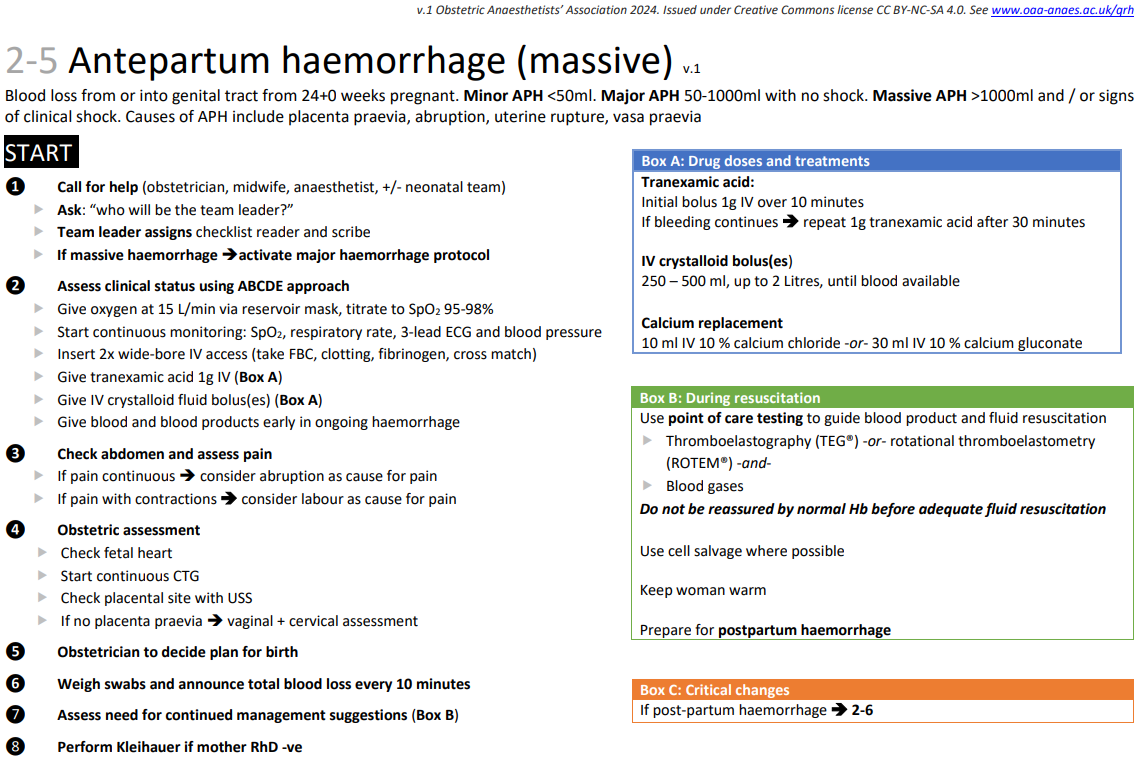
Tap image to enlarge in a new window.
Postpartum Haemorrhage
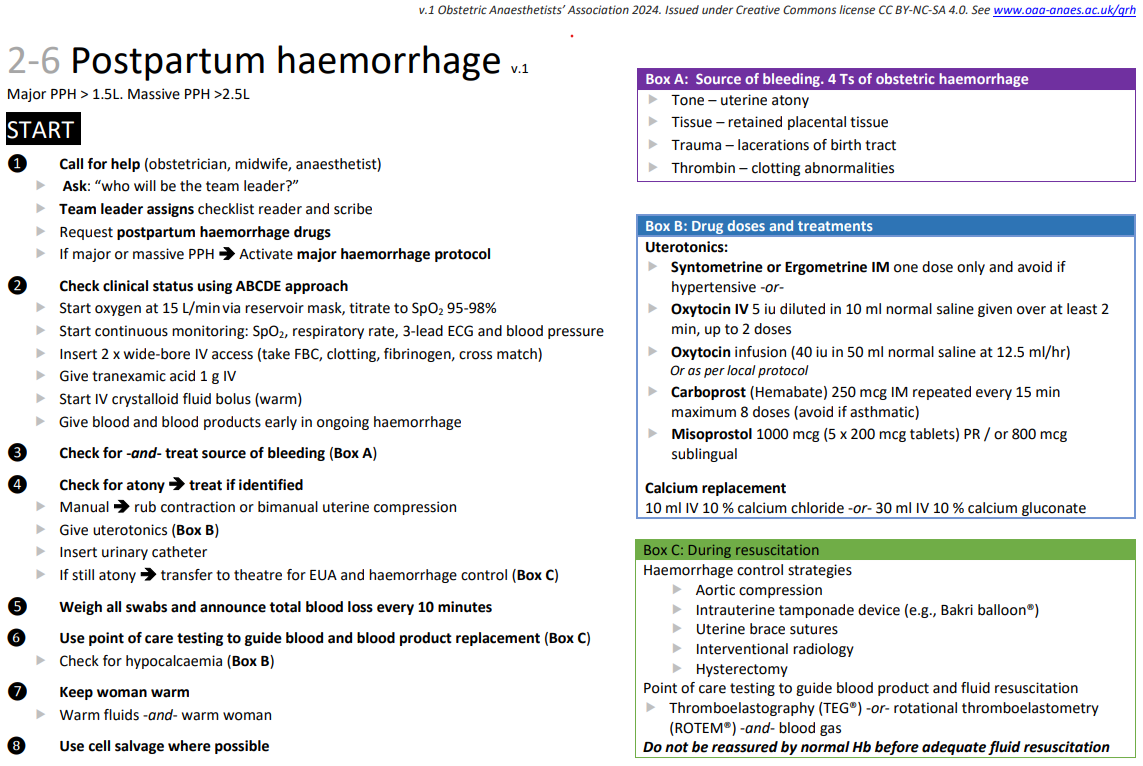
Tap image to enlarge in a new window.
| Class | % | Blood loss | Clinical signs |
|---|---|---|---|
| I | 5 | - | Normal BP & HR. Usually asymptomatic. |
| 10 | - | ||
| II | 15 | - | HR 100–120. BP maintained. Tachypnoea, mild anxiety. |
| 20 | - | ||
| 25 | - | ||
| III | 30 | - | HR 120–140. Hypotension. Confusion, oliguria. |
| 35 | - | ||
| IV | 40 | - | HR >140. Profound hypotension. Lethargy / coma, anuria. |
| 45 | - | ||
| >50 | - |
Clinical Pearl: Uterine contraction immediately post-delivery results in an autotransfusion of ~500 mL into the systemic circulation. Combined with maternal hypervolaemia, this allows women to compensate for massive blood loss, often masking the signs of shock until a critical cliff-edge is reached.
*Fibrinogen: Pregnancy is a prothrombotic state with a high baseline fibrinogen (4–6 g/L). It drops rapidly during major haemorrhage, so the obstetric target (> 2.0 g/L) is higher than the standard adult target.
Note: In ongoing major obstetric haemorrhage, empiric blood products (e.g., Major Haemorrhage Packs) should be administered immediately without waiting for laboratory results.
*TXA Redosing: If bleeding continues after 30 min, or stops and restarts within 24 h of the first dose, a second dose of 1 g of tranexamic acid can be given.
**Cryoprecipitate / Fibrinogen Concentrate: Request early with Pack A if FibTem / lab indicates rapid fibrinogen depletion (< 2.0 g/L).
ROTEM — Fibrinogen Concentrate
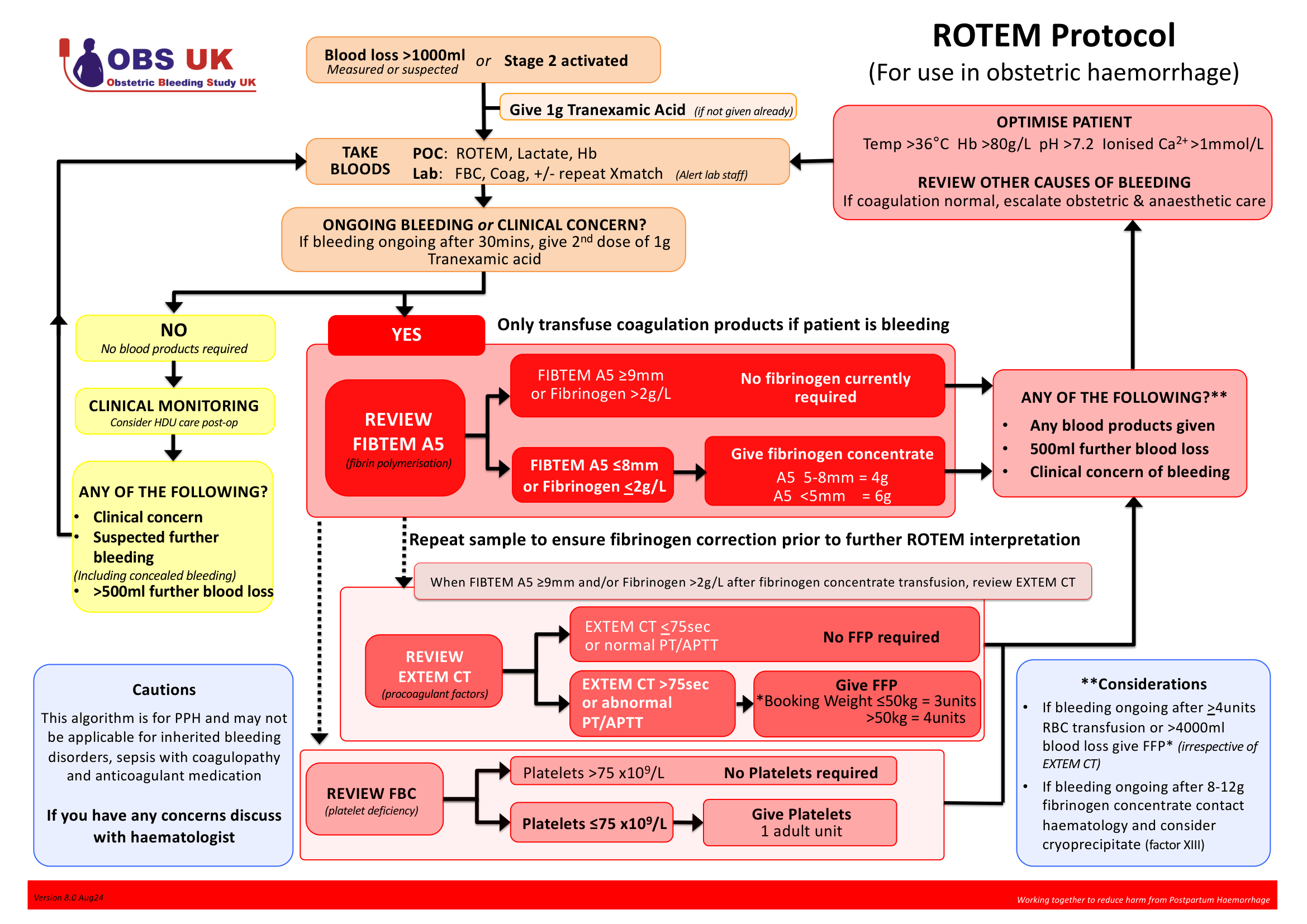
Tap image to open in new browser window
ROTEM — Cryoprecipitate
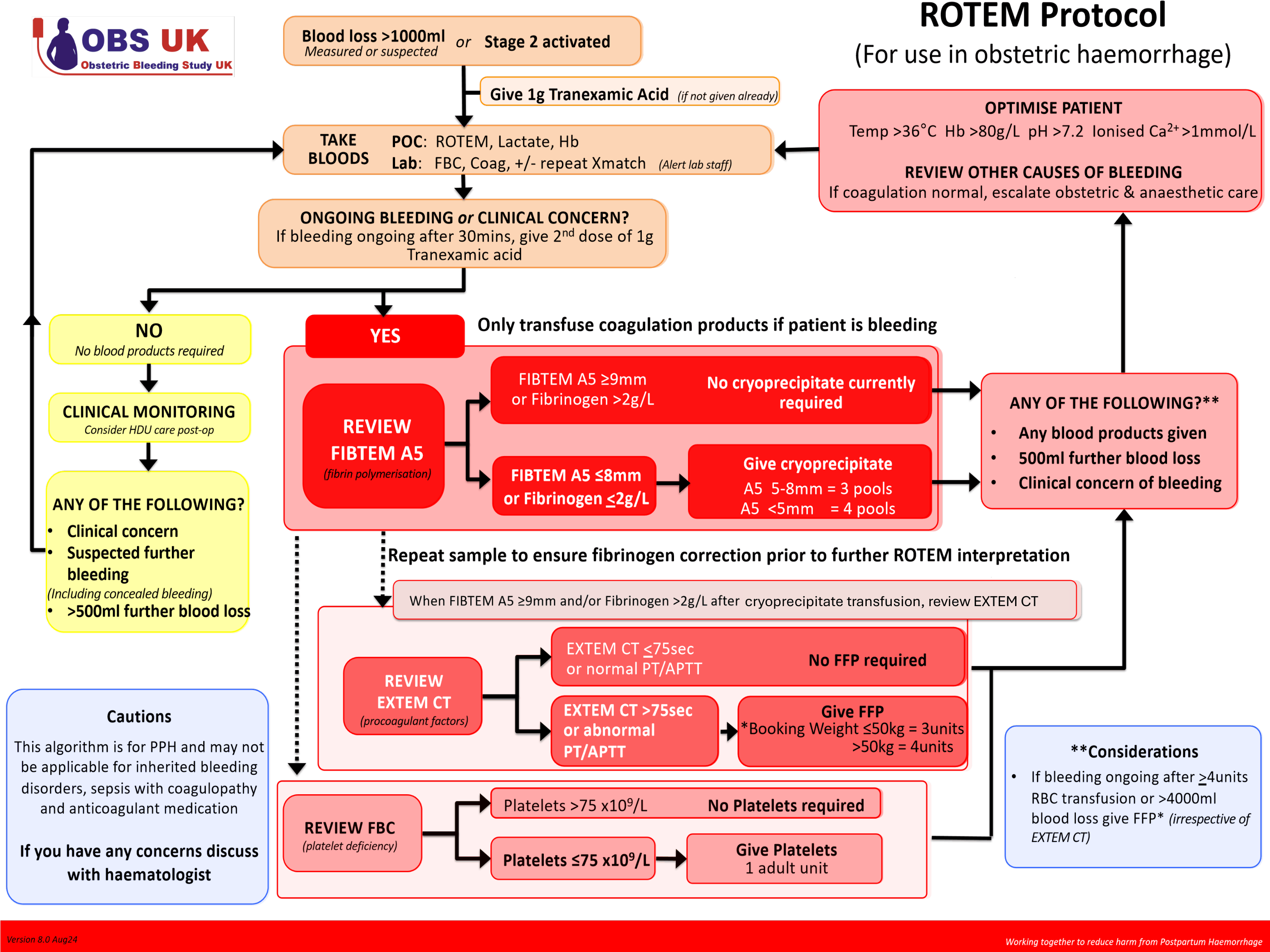
Tap image to open in new browser window
TEG — Fibrinogen Concentrate
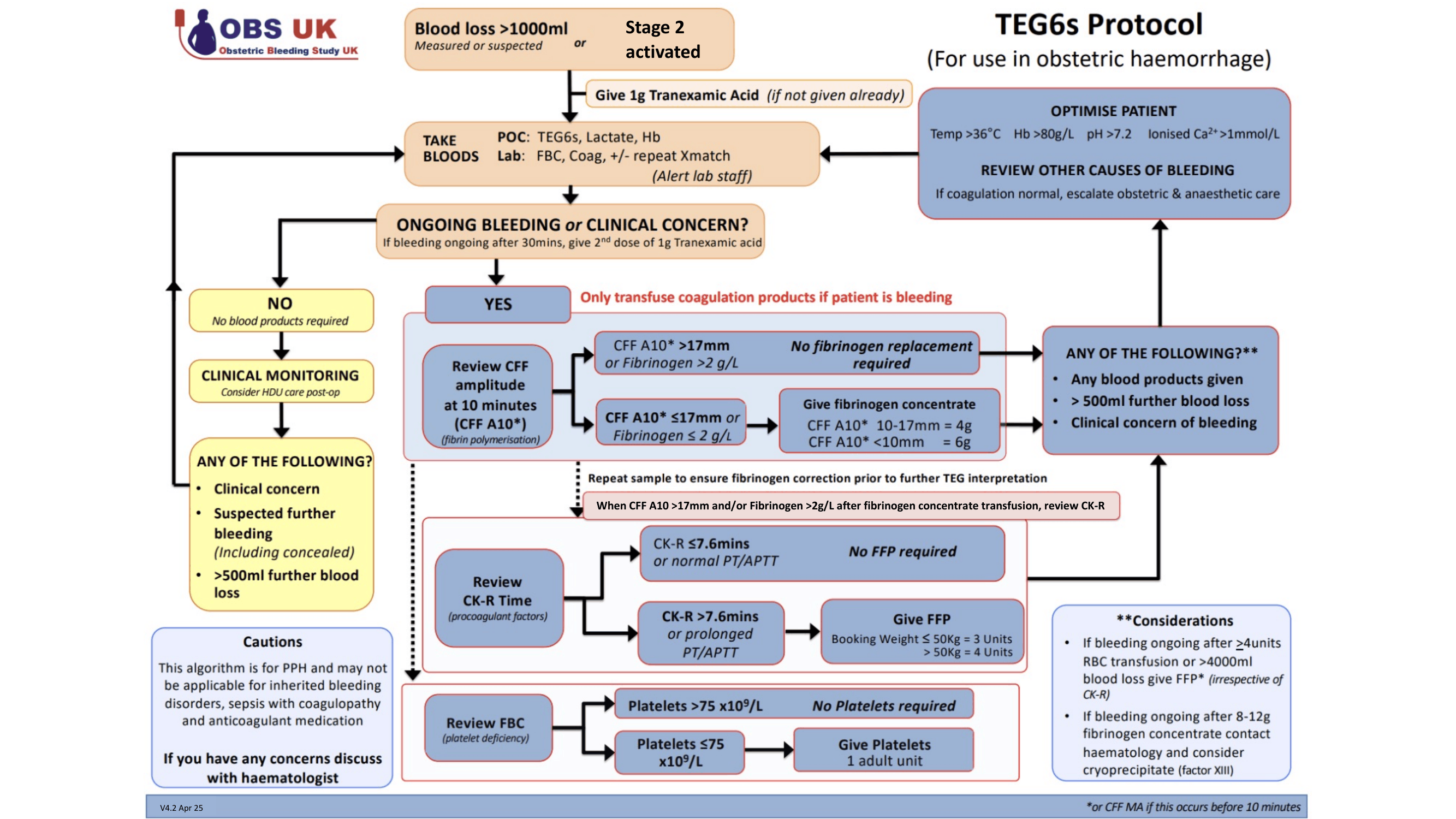
Tap image to open in new browser window
TEG — Cryoprecipitate
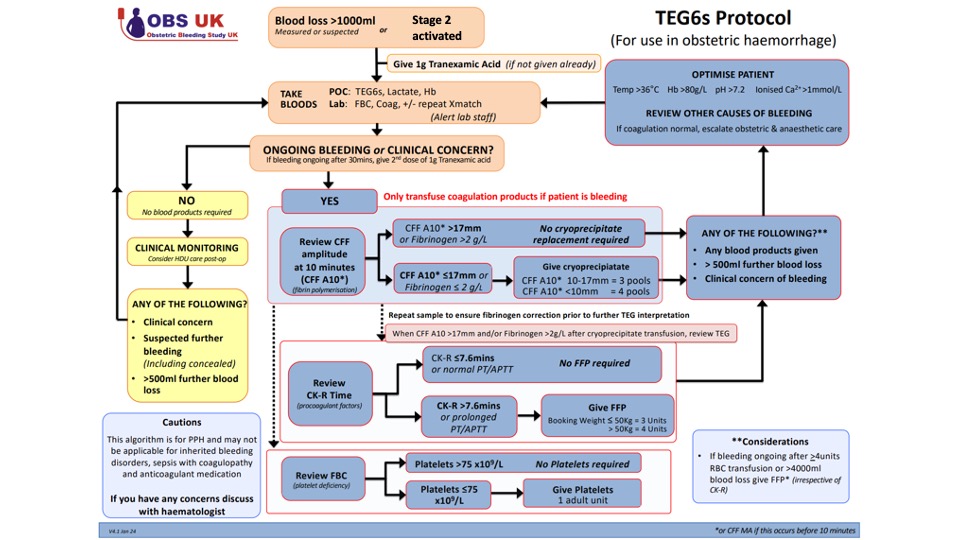
Tap image to open in new browser window